
All Chips on 17 Black: Jensen Huang and the AI Boom
Nvidia is worth $5.4trn, making its boss Jensen Huang a rockstar. To keep the AI boom going, Nvidia acts like a bank, guaranteeing loans for its buyers. If regular office workers don't start using AI as much as coders do, this gamble could fail.
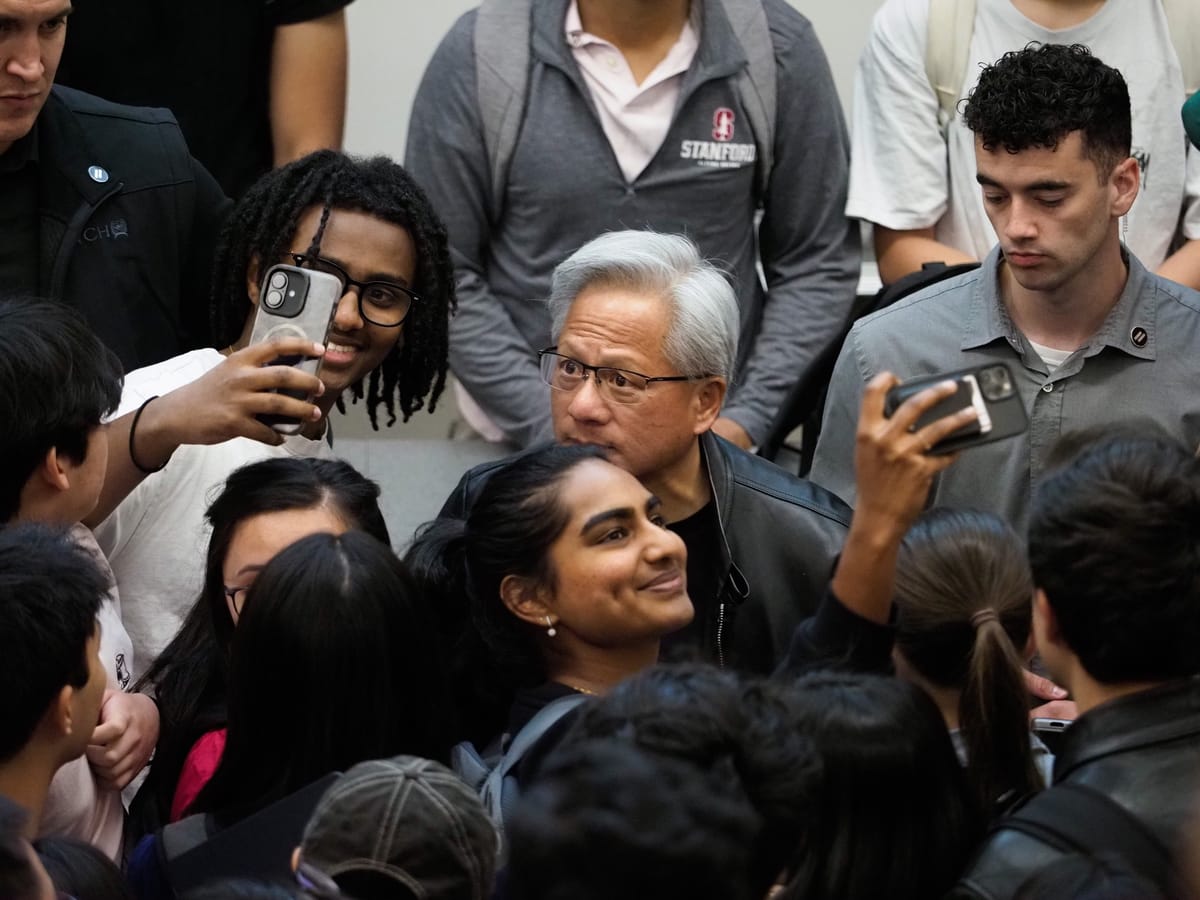
For a few days every June, the city of Taipei is abuzz. Crowds wait outside restaurants in the boiling heat. Whenever a black car drives past, people point and stare. They're looking for Jensen Huang.
Huang runs Nvidia, an American company named after the Latin word for envy. Today, Nvidia designs the powerful computer chips that run AI. Insatiable demand for these chips has pushed the firm's value to $5.4trn, making it the most valuable company on the planet. Next year, it might bring in $370bn in net profit.
In Taiwan, Huang is a local hero. Mark Zuckerberg once called him the Taylor Swift of tech. During his visits, Huang happily walks through night markets, joking with street food vendors. He once offered to buy dinner for an entire queue if they let him skip to the front. One night, he wrote "Jensen was here" on the tiles of a restaurant toilet. Almost instantly, a queue formed just to take photos of the bathroom wall. Fans buy tees printed with his face, and locals openly swoon over his smooth skin.
But behind the selfies and the trademark leather jackets, Huang is playing a very high-stakes games.
Why is a chipmaker acting like a central bank?
Nvidia is the main supplier of the AI gold rush. yet, it's also acting as the bank that funds the miners.
Over the past three years, Nvidia has offered $300bn in financial support to its own customers. For example, the company promised a $105bn backstop for a giant data centre in Ohio. Nvidia has also teamed up with Wall Street firms for a $500bn push to build more AI infrastructure. If a buyer misses their income targets, Nvidia sometimes promises to top up their cash.
This makes some market watchers nervous. They remember the dotcom crash of 2000. Back then, tech companies like Cisco and Lucent lent billions to telecoms networks so they could buy their gear. When internet demand fell short, the buyers went bust, and Cisco took massive losses.
However, Nvidia argues things are different today. Unlike the dotcom companies that relied heavily on debt, Nvidia is sitting on a mountain of cash. The firm holds $99bn in the bank and expects to yield $200bn in cash this year alone. Even if all its financial guarantees triggered at once, Nvidia would likely survive because it churns out so much pure profit.
Are Nvidia's best customers turning into its biggest rivals?
Nvidia has to be clever with its money because its biggest buyers are changing. Tech giants like Amazon, Google, Meta, and Microsoft provide about half of Nvidia's revenue.
These giants are now designing their own chips. Their custom chips cost a fraction of Nvidia's prices and can perform certain tasks better. Forecasters think these custom processors could capture 50% of the market by the end of the decade.
To fight back, Nvidia is heavily funding smaller cloud startups, known as "neoclouds." These smaller firms have to pay much higher interest rates on their loans that Google or Amazon do. To help them, Nvidia steps in to guarantee the future value of the hardware or promises to buy their unused computing power. This safety net makes banks comfortable lending money to the startups, which then use the cash to buy more Nvidia chips.
Who is actually using all this AI?
All this spending assumes people will keep paying to use AI. If the global tech industry wants to cover its massive data centre bills, AI needs to generate about $2.5trn a year by 2030. Right now, it makes roughly $150bn.
So far, software coders are driving this demand. Roughly 80% of programmers use AI tools. Startups that make AI for coding have seen their combined yearly revenue jump from $800m to $6bn in less than a year.
Coding is perfect for AI. The internet is packed with open-source code for the models to learn from. If an AI writes bad code, other software can test it and catch the mistakes instantly. Furthermore, software engineers are natural early adopters of new technology.
Other jobs are much harder to crack. Lawyers and customer service workers deal with human emotions, strict regulations, and messy, hidden data. You cannot easily test if a customer feels less angry after a chat. If regular office workers don't start using AI as much as coders do, overall demand could slow down. If that happens, Nvidia's customers might fail, leaving the chipmaker to pay out those massive financial guarantees.
How does a tech boss handle the China tightrope?
Beyond the financial risks, Huang has to navigate tricky geopolitics. The American government actively tries to stop China from getting advanced computer chips. Meanwhile, Taiwan, where Nvidia's chips are actually manufactured, faces constant military threats from China.
Huang manages this by playing the diplomat. He once joined Donald Trump on Air Force One for a trip to Beijing. While there, Huang took a seat on the advisory board of Tsinghua University, a top Chinese institution. This made some American politicians furious. Steve Bannon called him an "agent of influence" for China and demanded his arrest.
Yet, Huang also champions Taiwan. He calls the island his "business home" and plans to invest around $150bn there every year. To keep American politicians happy, he changes his language. He calls data centres "AI factories," knowing that politicians like Trump love the idea of American manufacturing.
What is it like to work for the people's dad?
In Taiwan, locals affectionately call Huang "the People's Dad." Inside Nvidia, however, he's a fiercely demanding boss.
Around 60 people report directly to him, which is unusually high for a chief executive. He does not tolerate excuses and gives blunt feedback in front of everyone. He believes the whole room should learn from a public bruising. His leadership team meetings focus entirely on problems; they rarely discuss good news.
Despite this rough treatment, his senior team has stayed with him for two decades. Huang has built a culture where people know their mistakes will be highlighted, but they will not be fired for making them. It also helps that he has turned many of his top staff into billionaires.
When asked what drives him, Huang gives a surprisingly simple answer. He doesn't want to colonise space of defeat death, unlike his friend Elon Musk. He just wants his staff and partners to do well. "Maybe," he says with a smile, " I'm just not sufficiently ambitious." ⬣



Comments ()